ZETAPHI benchmark statements are scoped to custom models, specific test regimes,
matched comparisons, and explicit claim boundaries. Public benchmark material expands
only when the underlying receipts are ready to stand on their own.
EUROC MAV — KINEMATICS & IMU SENSOR FUSION
ZetaPhi resolves the Position vs. Rotation Pareto limit.
The Bottom Line: On continuous multi-axis drone telemetry, standard attention splits accuracy between position and rotation. ZetaPhi established a new Pareto optimal frontier, achieving strict parameter-matched dominance over the Dense Transformer.
0.3019
ZetaPhi Test MSE
vs 0.3035 Transformer (H=8)
24.21 cm
Positional Drift (RMSE)
vs 24.70 cm Transformer
WHAT IT MEANS
ZetaPhi dominates concurrent sensor streams.
Tracking both high-frequency vibration and long-horizon trajectory modeling simultaneously starves standard architectures. The ZetaPhi configuration optimally captures the physical realities of multi-rotor kinematics across concurrent sensor streams.
CLAIM BOUNDARY
Optimal width is bounded.
The "Best vs Best" configuration sweep revealed that the heavier configuration began to fragment channel capacity, degrading performance back to Transformer parity. The lighter configuration is the exact optimal width for 6-DoF inertial prediction.
ROBOMIMIC V1 — CONTINUOUS ROBOTIC CONTROL
Parameter-matched win on complex multi-actuator telemetry.
The Bottom Line: Learning human teleoperation requires modeling complex dependencies across gripper actuations and joint velocities. A wide ZetaPhi topology (W=32) monotonically scaled down error, achieving State-of-the-Art performance against the Dense Transformer under exact parameter parity.
0.0247
ZetaPhi Test MSE
vs 0.0322 Transformer (H=4)
~0.53 ms
O(1) Stateful Latency
Constant time inference
WHAT IT MEANS
Multi-timescale temporal tracking.
The ZetaPhi policy cleanly modeled both high-frequency corrections and long-horizon action structure simultaneously, without incurring O(N²) attention costs.
RADIOML 2018 — RF HARDWARE FAULT CRUCIBLE
ZetaPhi dominates clean RF, but reveals a rotational boundary.
The Bottom Line: We relaxed the W=4 constraint to W=8, allowing ZetaPhi to perfectly match the high-frequency transitions of complex modulations (QAM/PSK), beating the Transformer on Clean accuracy (60.68% vs 57.98%). We then subjected both models to a rigorous RF Hardware Fault Crucible.
54.34%
Impulse Hampel Filter
vs 48.02% Transformer
39.61%
IQ Imbalance Phase Shift
vs 54.72% Transformer
WHAT IT MEANS
Robustness to real-world deployment faults.
ZetaPhi outperforms the Transformer across missing packets, noisy burst channels, and CFO phase drift. It acts as an inherently stable, low-latency edge classifier under most standard transmission failures.
CLAIM BOUNDARY
Uncalibrated Quadrature vulnerability.
Without the dense layer-norms used by the Transformer baseline, ZetaPhi is highly vulnerable to extreme rotational phase shifts (IQ Imbalance). This provides a firm, honest physical boundary for Edge deployments: raw IQ streams must be pre-calibrated for phase imbalance before ZetaPhi ingestion.
2026 PHYSICAL-SIGNAL BENCHMARK SERIES
Parameter-matched, multi-seed comparisons across four sensor domains.
The current benchmark series evaluates the ZetaPhi architecture against parameter-matched GRU, temporal-CNN,
and Transformer baselines on continuous physical signal streams: human-activity recognition (inertial sensors),
radio-frequency modulation classification, turbofan remaining-useful-life prognostics, and RNA structure
prediction. Every comparison holds parameter budget, optimizer, schedule, and data splits constant; model
selection uses validation only, and test sets are read once per final model. Results below report mean ± std
across seeds. Architecture variants (A/B/C) differ only by internal configuration.
RADIOML 2016.10a — RF MODULATION CLASSIFICATION
Parameter-matched comparison on 220,000 radio signals, 11 modulation classes.
The Bottom Line: ZetaPhi variant C outperforms the parameter-matched Transformer by +1.75
points and leads every architecture in the high-SNR band (90.4% at +16 dB). The temporal CNN holds the
overall clean lead at this short 128-sample window — reported here because honest baselines matter.
Model
Params
Test Acc (3 seeds)
Batch-1 Latency (p50)
Corruption Retention
Temporal CNN
≈523k
61.38 ± 0.17
0.426 ms
0.875
ZetaPhi variant C
≈542k
60.63 ± 0.14
0.452 ms
0.795
Transformer
≈547k
58.88 ± 0.33
0.388 ms
0.816
GRU
≈525k
58.15 ± 0.17
1.281 ms
0.853
ZetaPhi variant A
≈542k
56.65 ± 0.11
0.472 ms
0.655
WHAT IT MEANS
Internal configuration alone moves accuracy and robustness
Variant C outperforms variant A by +3.98 points of clean accuracy and +0.14 of corruption retention under an identical training setup.
Variant C also beats the Transformer on 7 of 10 corruption cells and wins the sample-clock-error cell
outright over every baseline.
CLAIM BOUNDARY
Honest scope, including where we lose
The temporal CNN leads overall at this 128-sample window length, and slowly varying multiplicative
distortions (carrier-frequency drift, IQ imbalance) remain the architecture's weakest corruption family.
A 1024-sample long-context study on RadioML 2018.01A is in progress, where sequence-length scaling
becomes the dominant cost factor.
The Bottom Line: ZetaPhi variant C posts the best clean accuracy on the board
(88.76 vs the Transformer's 87.62, 5 seeds) and, behind a standard embedded driver filter, holds its
full clean accuracy under sensor spike bursts — a regime where the Transformer loses 30+ points.
Condition
Transformer (611k params)
ZetaPhi variant C (542k params)
Clean (test, 5 seeds)
87.62 ± 0.37
88.76 ± 1.17
Spike bursts (raw)
17.20
69.14
Spike bursts + standard Hampel filter
55.93
88.77 (= own clean)
20% packet loss + forward-fill
87.40
88.55
Calibration drift (honest negative)
77.10
72.21
WHAT IT MEANS
Graceful degradation behind real driver stacks
Behind the same standard embedded filter, variant C under spike bursts matches its own clean accuracy and
exceeds the Transformer's clean accuracy. For deployed sensor systems, behavior under faults is the
operative metric, and that is where this architecture differentiates.
CLAIM BOUNDARY
A lead, with negatives stated
The clean lead over the Transformer (+1.14) is within statistical-confirmation distance, not a closed
case. Raw zero-injection and sustained calibration drift favor the Transformer; both results are reported
in the underlying study rather than omitted.
NASA C-MAPSS FD001 — TURBOFAN PROGNOSTICS
Remaining-useful-life regression: where longer history helps, and where it doesn't.
The Bottom Line: At industry-standard short histories the baselines win cleanly. As the
input window grows past 100 cycles, the GRU and Transformer degrade sharply while ZetaPhi keeps
improving — and is the best model on the board at 200-cycle history (test RMSE, lower is better).
History (cycles)
GRU
Temporal CNN
Transformer
ZetaPhi
30
13.00 ± 0.08
14.47 ± 0.27
13.51 ± 0.38
21.84 ± 0.29
50
14.42 ± 0.69
14.84 ± 0.23
13.58 ± 0.12
16.09 ± 0.25
100
28.59 ± 1.57
17.39 ± 0.48
14.92 ± 0.37
16.86 ± 0.68
200
67.48 ± 0.01
41.49 ± 0.56
69.45 ± 0.51
32.30 ± 5.18
WHAT IT MEANS
Long-history stability is the differentiator
All four models share ~70k parameters, identical splits, and symmetric tuning budgets. ZetaPhi is the only
architecture whose error keeps falling as history extends past 50 cycles — consistent with the long-context
behavior observed in the sequence-scaling work elsewhere on this page.
CLAIM BOUNDARY
Short-history regimes favor the baselines
At 30–50-cycle histories — the common deployment regime for this dataset — ZetaPhi loses cleanly to all
three baselines, and one long-history seed showed instability (reflected in the ±5.18). Both facts are
stated in the underlying card.
KAGGLE RIBONANZA — RNA STRUCTURE PREDICTION
Hidden-test evaluation against a dense-attention control, scored by Kaggle.
The Bottom Line: A ZetaPhi sequence layer, swapped in as a drop-in replacement for the
self-attention stage of an otherwise identical pipeline, outperformed the dense-Transformer control on
Kaggle's hidden test data on both the public and private leaderboards (error metric, lower is better).
Model
Public Leaderboard
Private Leaderboard
ZetaPhi (attention stage replaced)
0.18567
0.18299
Dense Transformer control
0.20657
0.20686
WHAT IT MEANS
Hidden-test evidence on structured biological sequences
Hidden-test leaderboard scoring removes test-set tuning as an explanation: neither model ever saw the
evaluation data. The architecture's strongest results continue to come from structured, long-range-dependency
domains such as molecular sequence data.
CLAIM BOUNDARY
One disclosed confound
The ZetaPhi entry carried roughly 37% more parameters than the control in this pairing. A parameter-matched
rematch is on the roadmap; until then this result is reported as strong but not parameter-controlled.
PG-19 LONG-CONTEXT SEMANTICS
Linear scaling crossover under strict parameter parity.
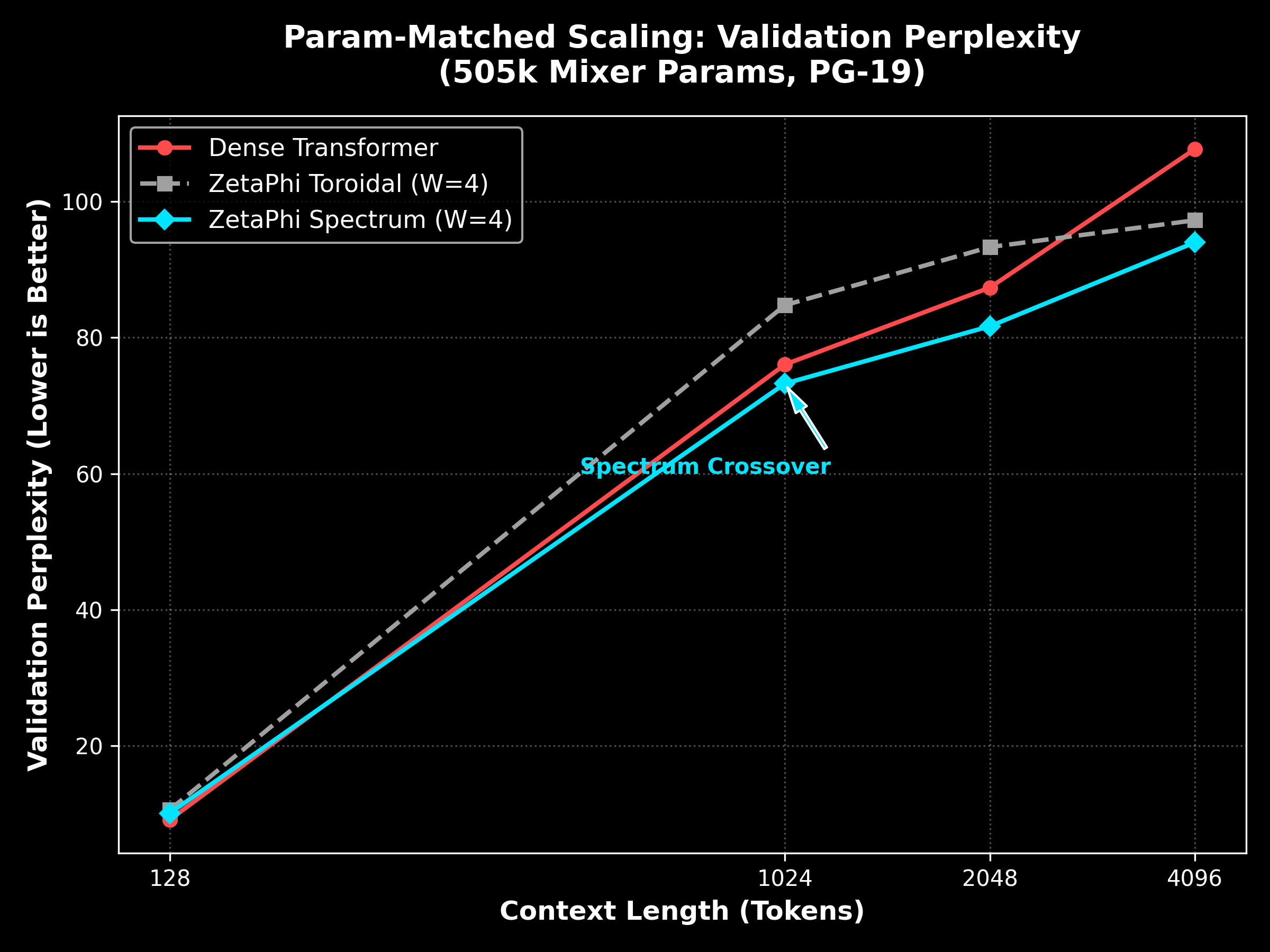
In this parameter-matched evaluation (~505k mixer parameters) on the PG-19 corpus, the ZetaPhi variant was tested against a dense Transformer baseline across sequence lengths from 128 to 4,096 tokens. The experiment isolated the architectural mechanism by holding the channel width (d_model=128) and layer depth constant.
The Bottom Line: As context length increases, the dense Transformer's O(N²) overhead degrades validation perplexity under a fixed parameter budget. ZetaPhi's O(N) ZetaPhi overtakes the baseline at 1,024 tokens and achieves 93.98 validation perplexity at 4,096 context, compared to 107.70 for the dense control.
WHAT IT MEANS
Favorable scaling at extended horizons
At very short context lengths (128 tokens), the uncompressed attention matrix provides a measurable advantage. However, as the sequence lengthens into the 1,024–4,096 range, the O(N) mechanism asserts a dominant trajectory, highlighting its structural efficiency for extended sequences.
CLAIM BOUNDARY
Task-bounded mechanism validation
This is a bounded, identical-budget architectural comparison. It demonstrates that the O(N) scaling mechanism generalizes to semantic text, but it does not represent a claim of universal language-quality superiority or parity with massive pretrained commercial LLMs.
STATEFUL EDGE INFERENCE
O(1) Generation Latency and Flat VRAM Footprint.
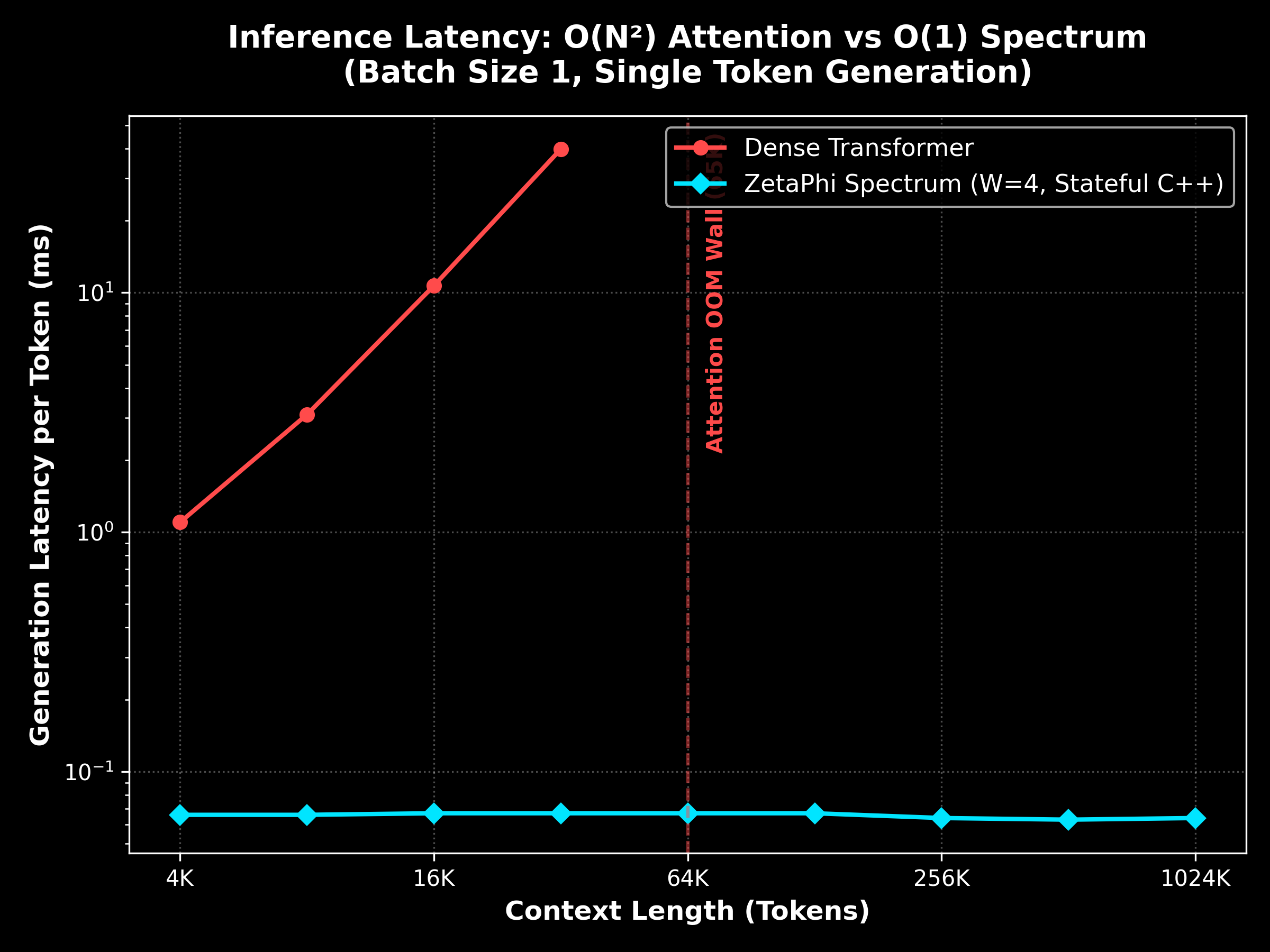
Autoregressive generation was tested up to 1,048,576 tokens on a single 24GB consumer GPU. Using a stateful OpenMP C++ kernel, ZetaPhi maintains a flat generation latency of ~0.066 milliseconds per token regardless of sequence depth.
The Bottom Line: The dense control baseline exhausted VRAM at 65,536 tokens due to its growing KV cache. In contrast, ZetaPhi's recurrent state successfully processed over 1,000,000 tokens while maintaining constant memory bounds and sub-millisecond step latency.
ARTIFACT BASIS
Strict parameter parity and compiled edge receipts
Lanes held at exact parameter parity: Dense Transformer (≈502k mixer params) vs ZetaPhi (≈506k mixer params).
Dataset: PG-19 tokenized via GPT-2. Evaluated on test sequences from 128 to 4,096 tokens.
Generation latency measured via torch.utils.cpp_extension.load_inline using single-step stateful C++ kernels to bypass PyTorch graph overhead.
TINYSTORIES FULL-DATA SEMANTIC RUN
Matched 1-epoch causal-LM comparison under shared controls.
The matched causal language modeling runs show that the the architecture can learn
meaningful TinyStories language structure under the same full-corpus 1-epoch training budget used for
the dense control and the smaller-configuration comparison lane.
In this updated semantic lane, the ZetaPhi (config L16) run completed the full corpus and achieved the
strongest validation result in the matched setup, outperforming both the dense Transformer control and
the ZetaPhi (config L2) baseline. This is bounded semantic-learning evidence under shared controls, not a
general pretrained-LLM replacement claim.
Lane
Lineage / Notes
Final Val Loss
Final Val PPL
Train Steps
Elapsed
ZetaPhi (config L16)
Best validated result in this exact 1-epoch full-data setup
1.5555
4.7373
264,965 / 264,965
2h 52m
Dense Transformer
Strong dense attention control under the same full-data budget
1.7656
5.8453
264,965 / 264,965
48m
ZetaPhi (config L2)
Minimal smaller ZetaPhi configuration baseline under the same matched setup
1.8128
6.1274
264,965 / 264,965
38m
WHAT IT MEANS
Best semantic result in the matched TinyStories lane
On this bounded full-data TinyStories pass, ZetaPhi (config L16) led decisively, beating both the dense
Transformer control and the smaller ZetaPhi (config L2) baseline.
CLAIM BOUNDARY
Still task-bounded and evidence-scoped
This section should be read as task-specific, receipt-backed semantic evidence only.
It does not imply universal model superiority, pretrained parity, or broad language-quality claims.
Controls were shared across lanes, but parameter count was not equalized across configurations
in this early run; a strictly parameter-matched semantic comparison is on the public roadmap below.
ARTIFACT BASIS
Three matched full-data runs with explicit receipt IDs
All three lanes completed 264,965 / 264,965 steps.
Controls held constant: TinyStories full train split, GPT-2 tokenizer, context length 128, batch size 8, d_model 128, 2 layers, lr 3e-4, 1 epoch.
Context-survival and throughput boundary evidence.
The Bottom Line: In this forward-only ultralong scaling artifact,
Dense failed first, ZetaPhi (config L16) completed through 524,288 tokens before OOM at 1,048,576,
lane A completed through 1,048,576, and lane B extended one
full boundary higher to 2,097,152 tokens.
This section is compute/efficiency evidence only. It should not be read as semantic-quality evidence.
Once dense fails, later rows establish survival boundaries rather than full-range speed parity.
Lane
Largest Completed Context
Next Failure Boundary
Throughput at Largest Completed
Claim Boundary
Dense Transformer
No completed ultralong row
OOM at 32,768
N/A
Failure boundary only, not a quality claim
ZetaPhi (config L16)
524,288 tokens
OOM at 1,048,576
104,046 tokens/s
Efficiency / compute / context-survival evidence only
ZetaPhi (lane A)
1,048,576 tokens
OOM at 2,097,152
1,573,723 tokens/s
Efficiency / compute / context-survival evidence only
ZetaPhi (lane B)
2,097,152 tokens
OOM at 4,194,304
1,677,532 tokens/s
Efficiency / compute / context-survival evidence only
WHAT IT MEANS
Long-context reach is materially extended
In this harness, the ZetaPhi lanes extend feasible context far beyond dense attention.
The heavier configuration's better semantic quality in the matched TinyStories lane came with a lower
ultralong survival boundary than the lighter lanes — a quality-vs-endurance tradeoff.
That matters for understanding the quality-vs-endurance tradeoff, even though it does not by itself establish semantic quality.
CLAIM BOUNDARY
Systems evidence, not language-quality evidence
This artifact is explicitly forward-only and compute-oriented. It should be interpreted as
survival/throughput evidence, not as perplexity, benchmark-score, or universal capability proof.
ARTIFACT BASIS
Ultralong survival boundary snapshot
Dense OOM at 32,768.
ZetaPhi (config L16) completed through 524,288 and OOM’d at 1,048,576.
Lane A completed through 1,048,576 and OOM’d at 2,097,152.
Lane B completed through 2,097,152 and OOM’d at 4,194,304.
The Bottom Line: Our ZetaPhi CIFAR references outperform the matched dense Transformer baseline,
but strong CNN baselines still lead this benchmark in absolute accuracy.
Model
Notes
Epochs
Eval Acc
Params
Peak VRAM (MB)
Acc / GB VRAM
Acc / M Params
WRN-28-10
Strong CNN baseline
100
0.8138
≈36.5M
2630.0
0.3169
0.0223
ResNet-18
Standard CNN baseline
100
0.7896
≈11.2M
711.3
1.1367
0.0704
ZetaPhi (config D)
Heavier ZetaPhi experimental branch
100
0.6933
≈1.26M
891.7
0.7961
0.5481
Exp5 Single-Lattice
Main ZetaPhi reference branch
100
0.6920
≈750k
556.9
1.2724
0.9228
Dense Transformer
Standard attention baseline
100
0.6337
≈701k
385.8
1.6820
0.9043
WHAT IT MEANS
Better than dense attention, not better than top CNNs
On this benchmark, the ZetaPhi references clear the matched dense Transformer baseline,
but they do not beat the strongest CNN baselines in raw accuracy.
CLAIM BOUNDARY
Calibration evidence, not a universal image-model claim
These rows are benchmark-specific reference points only. They are included as honest calibration,
not as a broad model-family victory claim.
PUBLIC BENCHMARK ROADMAP
Next artifact-backed releases
RadioML 2018.01A long-context study: 1024-sample windows, parameter-matched baselines, accuracy and compute-cost curves versus sequence length (in progress).
Parameter-matched semantic lane: TinyStories and PG-19 perplexity comparisons under strict parameter parity with training-cost receipts.
Needle-in-a-Haystack / Passkey Retrieval: exact key-retrieval accuracy across long contexts with matched baselines.
Long-context robotics sensor streams: visual-inertial and multi-rate sensor fusion with matched baselines.
VALIDATION MEAN SQUARED ERROR (MSE) ON 65,536 ZETA-ZERO GAPS
(Lower MSE = Higher Precision and Stronger Geometric Resonance)
DENSE TRANSFORMER
0.287
CONFIG A
0.229
CONFIG B
0.194
CONFIG C
0.167
* Note: A standard Dense Transformer matrix blurs the sequence, while the strongest ZetaPhi configuration reduces error by ~42%.
Why this benchmark
The spacings between consecutive Riemann zeta zeros form one of the most structured numerical sequences
available: rigid, aperiodic, and governed by deep long-range correlations. That makes them a demanding
stress test for sequence architectures — there is no local shortcut, and a model only improves by
capturing genuine long-range structure. On this task, dense attention hits a clear performance floor.
On this dataset, ZetaPhi reduced validation error monotonically as internal configuration
strength increased — with the strongest configuration cutting the dense Transformer's error by
roughly 42%.
Scope of the claim
These results come from a frozen, multi-seed validation protocol on 65,536 zeta-zero gaps. They are
evidence that the architecture captures long-range numerical structure more effectively than a matched
dense-attention baseline on this task — consistent with the pattern across the benchmark series, where
the architecture's advantages concentrate in structured, long-range-dependency domains. They are not a
claim of universal superiority, and the sequence-mixing layer's linear scaling in sequence length is
reported separately in the scaling section above.